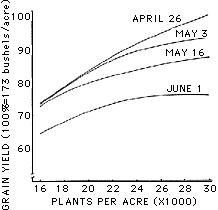
Figure 6. Effect of planting date and plant population on grain yields of a 110 RM (full season) corn hybrid (adapted from Corn Replanting: Is It Necessary, Crop News #46, D.R. Hicks).
This section will assist you in determining the extent of damage to the plants in your field and help you compare yield losses due to low plant populations and leaf damage with losses due to replanting at a late date. This section will also offer recommendations for varieties or alternate crops to use in replanting if it is deemed necessary and discusses how weed management decisions can affect your replant decision.
The first step is to determine the stage of growth at the time of the storm (refer to the growth and development section and Table 1 for information on this procedure). Next determine the number of surviving plants in the field for use in calculating the yield potential of the existing plants.
As a part of the assessment of a living or dead plant you will need to assess the health of the growing point. It is normally below the ground for 2 - 3 weeks after emergence of leaves and it is often protected from injury because of this. Check the condition of the growing point of several damaged plants by splitting the stalks down the middle. If healthy and undamaged it will be white in color and firm in texture. If damaged it will be discolored and watery due to bacterial and fungal infections. Plants with damaged growing points will not recover and should be counted as dead.
Examine plants from several areas of the field and determine the number of live plants per foot of row (make several counts in various areas of the field). Convert these numbers to plants per acre. Hail damage to corn can result in plants with their leaves tightly bound in a whorl (sometimes called buggy whips). The leaves are bound so tightly that the tassel cannot emerge by normal elongation of the internodes. Since it is impossible to predict if these will unfurl and resume normal development, they should be counted as dead when doing the remaining live plant counts.
Data from plant population studies show small yield differences for populations between 24,000 and 30,000 plant/acre for full season hybrids on fertile soils with good water holding capacity. Figure 6 shows the relationship between plant population, planting date, and yield. Large yield reductions can occur when plant populations drop below 18,000 plants per acre. Highest yields are therefore produced by earliest planting, high populations and full season hybrids. Optimum population varies with hybrid, fertility program and soil type.
Figure 6. Effect of planting date and plant population on grain yields of a 110 RM (full season) corn hybrid (adapted from Corn Replanting: Is It Necessary, Crop News #46, D.R. Hicks).
Table 2, which was adapted from the 1984 Revision of the NCIS Corn Loss Instruction booklet, can now be used to determine the yield potential of the remaining plants in your field. This table is valid for assessing damage to corn up to the 10 leaf stage.
| Stand Remaining | Yield Loss |
| % | % |
| 100 | 0 |
| 75 | -10 |
| 50 | -26 |
| 25 | -43 |
Next, determine the extent of leaf damage on the surviving plants. Carefully examine plants from several representative areas in the field to determine the amount of leaf area that is still functional.
Table 3 provides the estimated yield loss due to varying amounts of leaf area destruction for several stages of development. Note that the largest yield losses result from damage as the plant approaches tasseling and silking (NCIS 16 leaf through late milk stages). Use the previous defoliation and stage of growth data you gathered to determine from this table the amount of yield reduction due to leaf damage.
| Growth Stage | Percent leaf area destroyed | |||||
| 10% | 20% | 40% | 60% | 80% | 100% | |
| % yield loss | ||||||
| 7 leaf | 0 | 0 | 0 | 4 | 6 | 9 |
| 10 leaf | 0 | 0 | 4 | 8 | 11 | 16 |
| 13 leaf | 0 | 1 | 6 | 13 | 22 | 34 |
| 16 leaf | 1 | 3 | 11 | 23 | 40 | 61 |
| Tasseled | 3 | 7 | 21 | 42 | 68 | 100 |
| Late milk | 1 | 3 | 10 | 21 | 35 | 50 |
| Dented | 0 | 0 | 3 | 10 | 17 | 24 |
| *Adapted from Corn Loss Instructions NCIS publication #6102, Rev. 1984. | ||||||
As you can see from these data, leaf damage at early growth stages does not affect yield the same way as it does at later growth stages because much of the plant's total leaf area is yet to be exposed.
Figure 7 shows the amount of leaf tissue exposed on a corn plant at four stages of development. Extensive damage to plants in the 10 leaf stage of growth does not result in a large yield loss because 75% of the leaf area is yet to be exposed and the plant can easily recover from early damage. On the other hand, severe damage to plants during tasseling results in a large yield loss because by that time 100% of the leaf area has been exposed and cannot be replaced.
Figure 7. Percent of leaf area exposed at four stages of growth (adapted from NCIS #6102, Rev. 1984).
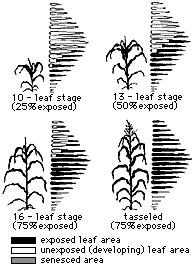
Figure 8 show ears produced on plants that were completely defoliated at the 15 leaf, silking and late milk stages. The graph below the sketches shows the pattern of yield reduction due to damage at various stages of growth. You can easily see from the sketches that yield reduction from defoliation at the 15 leaf stage is mainly due to fewer filled kernels on each ear. Since the ear is filled from the butt end to the tip, the plant was able to fill only about 50% of the kernels after the damage. This plant had between 50% and 75% of its leaf area exposed by the damage date (see Figure 7).
Figure 8. Effect of complete leaf removal on corn grain yield at various growth stages (data and sketches adapted from originals by R.K. Crookston).
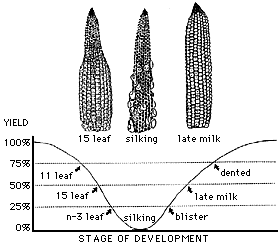
A plant 100% defoliated during tasseling and silking will still fill some scattered kernels. These kernels were filled from storage reserves in the stem, cob and husk tissue as the corn plant attempted to produce some viable seed. This plant had 100% of its leaf area exposed by the damage date (Figure 7).
Yield reductions due to severe damage in the late-milk stage are from smaller kernel size, since kernel number has already been determined and filling had begun. These kernels will be shrunken and chaffy compared to normal plump kernels from an undamaged plant's ear.
Next, determine the yield if you were to replant today. Early planting dates result in highest grain yields, earlier maturity in the fall, and grain lower in moisture content at maturity. Corn planting can begin in southern Minnesota by April 20 and in northern Minnesota by April 25. Figure 5 shows a commonly used calendar that describes the progress of corn development in Minnesota from planting to harvest. Corn yields are reduced about 0.5% per day (1/2 bu/A/day) through May (see Table 4 for percent yield loss for successively later May planting dates). When planting is delayed into June the yield penalty is much greater. Early planting dates allow use of full season hybrids which are usually higher yielding. Data collected by the Minnesota Agricultural Statistics Service indicate that 5% of the corn acreage is planted by April 25th increasing to 95% planted by May 30. About half the corn acreage is planted on or before May 11th each year (Figure 5).
| Date of Planting |
Approximate Yield Loss
% |
| Before May 1 | 0 |
| Between May 1 and 10 | -7 |
| Between May 11 and 25 | -13 |
| Between May 25 and June 1 | -24 |
Figures 9 and 10 show the effect of planting date, and hybrid maturity on calendar date for achievement of physiological maturity (32% kernel moisture) in central and southern Minnesota, respectively. These figures should be used to make the best hybrid maturity choice for late planting or replants after damage. Now use Table 4 and Figure 9 or 10 to determine the yield reduction for replanted corn. Compare the yield potential of the existing stand to the yield potential of the late planted hybrids.
Figure 9. Effect of planting date and hybrid relative maturity on date of physiological maturity (32% kernel moisture) in central Minnesota (adapted from Corn Hybrid Maturity for 1986, Crop News #72, D.R. Hicks).
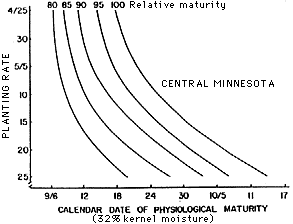
Figure 10. Effect of planting date and hybrid relative maturity on date of physiological maturity (32% kernel moisture) in southern Minnesota (adapted from Corn Hybrid Maturity for 1986, Crop News #72, D.R. Hicks).
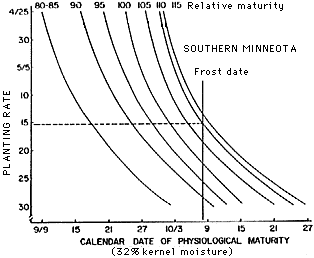
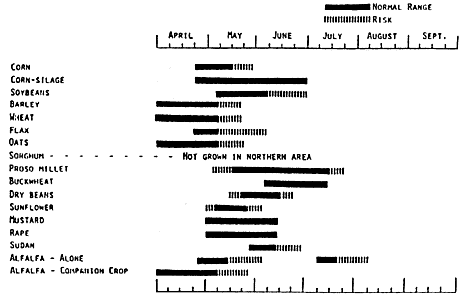
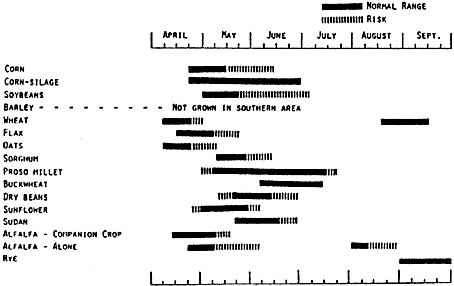
Table 5shows the recommended relative maturities of corn hybrids for various planting dates and zones in Minnesota. Following these suggestions should ensure a harvestable grain crop of good yield and quality. Note that as planting is delayed, earlier maturing hybrids are recommended. Use this table to select hybrids of the proper relative maturity for late planting or replanting. Figure 11 shows the boundaries of the maturity zones on a map of Minnesota. Sometimes replant decisions may be made so late into the growing season that replanting corn may not be economical so you might have to switch to another crop. See Figure 12 for information on planting date guidelines for some of these alternate crops.
| Zone | Planting Date | |||
| May 15 | June 1 | June 15 | July 1 | |
| Suggested relative maturity | ||||
| Northern | 80 | — | — | — |
| North Central | 90 | 85 | — | — |
| Central | 95-100 | 85-90 | 70 | — |
| South Central | 105 | 90-95 | 85 | 75 (silage) |
| Southern | 110-115 | 100-115 | 90 | 85 (silage) |
| *The relative maturity given in this table is "full season" for each date and zone (see Figure 11 for zone boundaries). Earlier maturity hybrids can be used. | ||||
Figure 11. Crop maturity zones in Minnesota (based on climatological data) (adapted from Minnesota Relative Maturity Rating of Corn Hybrids , Agronomy Fact Sheet #27, R.H. Peterson and D.R. Hicks).
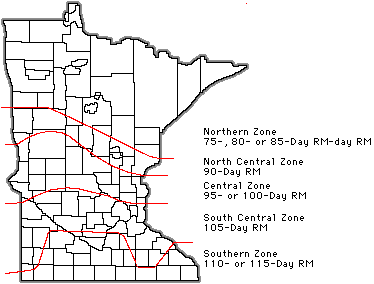
Figure 12. Normal and risk ranges of planting dates for various crops in northern and southern Minnesota.
Even if enough healthy plants (with good distribution in the row) remain after a hail storm to warrant leaving the stand, the weed status of the field is an important consideration in determining whether or not to replant. Corn will grow slowly following damage, depending on the amount of leaf loss and the weather. The rate at which corn recovers will influence its competitive ability with weeds and its sensitivity to various weed control practices.
In relatively weed-free fields, corn that is not too severely injured will probably recover and grow fast enough so that combinations of cultivation and application of postemergence herbicides will be effective. Effective cultivation requires weeds to be small (1 - 3 inches) and the crop tall enough to prevent it from being buried by soil. It is not necessary to cultivate deeper than 1 to 2 inches for most weeds. A shallow cultivation will effectively control annual weeds with little crop stress or soil moisture loss.
Early in the growing season, if a field to be replanted is especially weedy, a soil-applied herbicide may be needed on the second planting. To reduce the chance of crop injury to the replanted crop, select a herbicide that is suited to the soil and weed situation (see the current edition of Cultural and Chemical Weed Control in Field Crops, University of Minnesota Extension Service, BU-3157), but which is not in the same chemical family as the first herbicide (Table 6). For example, if the first crop of corn was treated with pendimethalin (Prowl), replanted corn should not be treated with Prowl. Use the Cultural and Chemical Weed Control in Field Crops to choose a herbicide from another chemical family that will control the weed species present in the field. Care must also be taken to choose a herbicide that, when applied this late in the growing season, will not present a carryover problem to next year's crop. For example, if the first crop was corn treated with Prowl, replanted soybeans should not be treated with Prowl, or chemicals similar to Prowl, such as ethalfluralin (Sonalan) or trifluralin (Treflan). See the individual herbicide labels for crop rotation restrictions. If you do re-treat the crop with the herbicide that was previously used, remember to check the label for the maximum registered amount of herbicide that can be legally applied and act accordingly.
| Chemical Family | Herbicides | Chemical Family | Herbicides | |
| Acetanilides | Acetochlor (Harness Plus) (Surpass) | Isoxazolidinones | Clomazone (Command) | |
| Alachlor (Lasso) | Sulfonamides 2 | Flumetsulam (Broadstrike) | ||
| Dimethenamid (Frontier) | Sulfonylureas | Chlorimuron-ethyl (Classic) | ||
| Metolachlor (Dual) | Thiocarbamates | Butylate (Sutan + ) | ||
| Propachlor (Ramrod) | EPTC (Eradicane, Eradicane Extra) | |||
| Benzoic Acids | Dicamba (Banvel) (Clarity) | Triazines | Atrazine | |
| Dinitroanalines | Ethalfluralin (Sonalan) | Cyanazine (Bladex) | ||
| Pendimethalin (Prowl) | Metribuzin (Sencor, Lexone) | |||
| Trifluralin (Treflan) | Simazine (Princep) | |||
| Imidazolinones 2 | Imazethapyr (Pursuit) | Ureas | Linuron (Lorox) | |
|
1
This table does not include package mixtures. Package mixtures contain
two of the herbicides listed above and are often referred to by trade
names that differ from those listed in the table. See the current
edition of BU-3157,
Cultural and Chemical Weed Control in Field Crops
, for a list of package mixture contents.
2 Although in different chemical families, these herbicides share a common mode of action and sequential treatment should be avoided. |
||||
In fields that require replanting but still have good weed control or in fields planted after mid-June, another application of a soil-applied herbicide is probably not necessary. The more persistent soil-applied herbicides used on the first planting should remain in sufficient quantity to give some weed control in the replanted crop and most weed seeds near the soil surface should have already germinated with the first crop. In weed-free fields the crop should be planted without any soil tillage or if necessary, soil should be tilled no more than 1.5 to 2 inches deep to avoid bringing weed seeds and untreated soil to the surface. Soil and air temperatures should be favorable for fast germination, emergence, and growth of the crop, giving the crop a competitive advantage over weeds. Germinating weeds can be controlled with rotary hoeing, cultivation, postemergence herbicides, or combinations of these practices. Rotary hoeing is effective on newly germinated weeds before they emerge from the soil (weeds in the white stage). After weeds emerge, the effectiveness of the rotary hoe rapidly diminishes. Corn up to the 2-leaf stage can be rotary hoed. However, be aware that rotary hoeing may compound injury to hail-stressed corn.
Postemergence herbicide applications can control many annual weeds in corn, provided the weeds are small enough (Table 7). Postemergence herbicides should not be applied until the corn has recovered from the hail damage and resumed growth. Until the weeds resume growth, hail stress may reduce herbicide effectiveness on both the broadleaf and grass weeds.
| Herbicide b | Product Rate | Pigweed |
Lamb's-
quarters |
Velvetleaf | Cocklebur |
Eastern
Black Nightshade |
Foxtail |
| ---------------leaf stage c /weed height(inches)--------------- | |||||||
| Atrazine 4L | 4.0 pt/A d | - e /6 | -/6 | -/4 | -/4 | -/1.5 | -/1.5 |
| Atrazine 4L | 2.4 pt/A | -/6 | -/6 | -/4 | -/4 | NL f | NL |
|
Bentazon 4S
(Basagran) |
2.0 pt/A | NL | 4-8/2 | 4-6/5 | 6-10/10 | NL | NL |
|
Bromoxynil 2EC
(Buctril) |
1.5 pt/A | 4/2 | -/8 | 6/5 | 8/10 | 6/6 | NL |
|
Clopyralid
(Stinger) |
0.5 pt/A | NL | NL | NL | 5/- | 4/- | NL |
|
Cyanazine 90 DF
(Bladex) |
2.2 lb/A | -/1.5 | -/1.5 | -/1.5 | -/1.5 | -/1.5 | -/1.5 |
|
Dicamba 4S
(Banvel) (Clarity) |
1.0 pt/A | -/4-6 | -/4-6 | -/4-6 | -/4 | -/2-3 | NL |
|
Dicamba 4S
(Banvel) (Clarity) |
0.5 pt/A | -/4 | -/4 | -/2 | -/2 | -/1 | NL |
|
Nicosulfuron
(Accent) |
0.66 oz/A | -/4 | NL | NL | NL | NL | -/4 |
|
Primisulfuron
(Beacon) |
0.76 oz/A | -/4 | -/<1.5 | -/4 | -/4 | -/4 | NL |
|
Pyridate 3.7EC
(Tough) |
2.0 pt/A | 4/- | 4/- | 4/- | 4/- | 4/- | NL |
| 2,4-D | 1.0 pt/A | -/1-3 | -/4 | -/1-2 | -/2-4 | -/2-3 | NL |
|
a
Maximum weed sizes were taken from the label, where possible. The
labeled maximum weed sizes would reflect control under ideal
conditions. Hail stress may decrease the weed size at which
satisfactory control is achieved.
b Please see the label for the proper additive to use with each herbicide. c When dealing with the leaf stage of hail-damaged weeds, be sure to count leaf scars to determine the weeds' real size. d Certain counties in Minnesota, as well as certain states, may have rate limitations in regard to Water Quality Best Management practices. Consult your state lead pesticide control agency or Extension Service for more information. e Leaf stage or weed height not given on label. f NL = Not labeled. |
|||||||
By the time corn plants have resumed growth, many weeds may be too big to control with herbicides. Therefore, if corn fields are severely hail-stressed and weedy and the grass and broadleaf weeds are near the weed sizes listed in Table 7 there is a difficult decision to be made. If the weed population is large and it isn't too late to replant, then replanting is advisable even though the crop plants would probably recover. If it is too late to replant a crop then cultivation is the only choice.
The use of postemergence herbicides to control later weed flushes poses several unique problems. A grower should be aware of applicable forage, feed, and grazing restrictions imposed by the Environmental Protection Agency (EPA) (Table 8). These restrictions are included on the herbicide label and are imposed by the EPA to prevent unacceptable levels of herbicides from entering grain and livestock food sources. Table 8 lists the forage, feed, and grazing restrictions for corn herbicides. It is very important that the applicator adhere to all label restrictions.
| Herbicide | Restrictions | Herbicide | Restrictions | |
| Acetochlor | No restrictions. |
Glyphosate
(Roundup) |
Do NOT
harvest or feed forage for 32 days after broadcast application.
Allow 14 days following spot treatment before grazing livestock. |
|
|
Alachlor
(Lasso 4EC) |
No restrictions. |
Glyphosate
(Ranger) |
Do NOT harvest or feed forage for 56 days after application. | |
|
Alachlor
(Lasso MT) |
No restrictions. |
Linuron
(Lorox) |
No restrictions. | |
|
Atrazine
(Atrazine) |
Do NOT graze or feed forage for 21 days after application. |
Metolachlor
(Dual) |
No restrictions. | |
|
Bentazon
(Basagran) |
Do NOT graze or feed forage for 12 days after application. |
Nicosulfuron
(Accent) |
Do NOT graze or feed forage or grain for 30 days after application. | |
|
Bromoxynil
(Buctril) |
Do NOT graze or feed forage for 30 days after application. |
Paraquat
(Gramoxone Extra) |
No restrictions. | |
|
Butylate + safener
(Sutan + ) |
No restrictions. |
Pendimethalin
(Prowl) |
No restrictions. | |
|
Clopyralid
(Stinger) |
Do NOT graze or harvest silage for 40 days after application. |
Primisulfuron
(Beacon) |
Do NOT graze or feed forage for 30 days after application. | |
|
Cyanazine
(Bladex) |
No restrictions. |
Propachlor
(Ramrod) |
No restrictions. | |
|
Dicamba
(Banvel) (Clarity) |
Prior to the ensilage (milk) stage, do NOT harvest or graze forage. |
Pyridate
(Tough) |
Do NOT graze or feed grain, forage, or fodder for 68 days after application. | |
|
Dimethenamid
(Frontier) |
Do NOT graze or feed forage for 40 days after application. |
Simazine
(Princep) |
Do NOT graze. | |
|
EPTC + safener
(Eradicane, Eradicane Extra) |
No restrictions. | 2,4-D (ester/amine) | Do NOT graze or feed forage for 7 days after treatment. | |
|
Flumetsulam
(Broadstrike) |
No restrictions. | |||
| 1 Restrictions for package mixtures are generally taken from the most restrictive product in the mixture. See the label for more details. See the current edition of BU-3157, Cultural and Chemical Weed Control in Field Crops , for a list of package mixture contents. | ||||
Another important consideration when using postemergence herbicides is the size or stage of growth of the corn plant at the time of herbicide application. Some herbicide labels refer to a particular leaf stage of corn development, others refer to corn height. Descriptions of corn leaf stage, as written on herbicide labels, are not based on the NCIS System described in Table 1. Rather, the herbicide labels refer to the number of visible corn leaves. For example, cyanazine (Bladex) must be applied before the fifth corn leaf is visible. Therefore, a postemergence Bladex treatment would include applications from corn emergence through the "4-leaf stage." All reference in the label is to visible leaves, not to collars or exposed leaves with tips pointed downward. Several postemergence corn herbicide labels refer only to corn height. Corn height is the free-standing height of the plant as measured from the base of the plant to the top of the whorl. Corn height is not the extended leaf height. Be sure to read the herbicide label carefully to understand its definition of crop size or stage of growth.
It is important to read and follow a postemergence herbicide label's time of application instructions very carefully. Several of the postemergence herbicides can severely injure the corn crop if applied at the wrong stage of growth. Atrazine should only be applied on corn up to 12 inches tall. Corn injury is most likely to occur when atrazine and oil are applied to corn growing under cold and wet conditions. Bentazon (Basagran) can be applied at any stage of corn growth. Bromoxynil (Buctril) can be applied to corn up to the tassel stage. Corn tolerance is good, but leaf burn can occur under conditions of high temperatures or humidity. Clopyralid (Stinger) can be applied to corn up to 24 inches in height. Corn tolerance is good and no adjuvant (i.e. surfactants or crop oils) should be added to Stinger. Cyanazine (Bladex) must be applied before the fifth corn leaf is visible. Do not use Bladex 4L postemergence. Vegetable oils or surfactants may be added under dry conditions to improve weed control effectiveness, but these additives increase the potential for corn injury and stand loss if heavy rain or dew and cool temperatures occur soon after application. Dicamba (Banvel) (Clarity) may be used at a rate of up to 1 pt/A on corn through the fifth leaf stage or 8 inches in height, whichever comes first. Apply 1/2 pt/A before corn is 3 feet tall or until 15 days before tassel emergence, whichever comes first. Do not use oils or other additives with Banvel. Late application of Banvel may increase crop injury and vapor drift to off-target crops. Crop safety is improved by using drop nozzles in corn over 8 inches tall. Nicosulfuron (Accent) may be applied over-the-top or corn that is 24 inches in height or less. Corn that is 24 to 36 inches high may only be treated with drop nozzles. Accent cannot be applied to corn that exceeds 36 inches in height or exhibiting 10 leaf collars, whichever occurs first. Generally, when height restrictions are followed crop tolerance is good, however, do not apply Accent to corn previously treated with any formulation of terbufos (Counter 15G or 20CR). The only exception is the application of Accent to corn previously treated with Counter 20CR applied in a band at planting. See the American Cyanamid Counter 20CR and Dupont Accent labels for details. Primisulfuron (Beacon) may be applied over-the-top of corn that is between 4 and 20 inches in height. Corn plants less than 4 inches or greater than 20 inches tall may be more susceptible to injury. Do not apply Beacon if any formulation of terbufos (Counter 15G or 20CR) is applied to the crop at any time during the growing season. Also, check the local label restrictions regarding corn hybrids that are known to be susceptible to Beacon herbicide. Corn is tolerant to pyridate (Tough) at all stages of development. To reduce 2,4-D induced crop injury, broadcast applications should be limited to corn in the 2- to 5-leaf stage or before corn is 8 inches tall. After corn exceeds the 8 inch height, use drop nozzles to prevent crop injury and reduce vapor drift. The amine formulation of 2,4-D is less likely to volatilize or injure corn than the ester formulation. Corn is tolerant to pyridate (Tough) at all stages of development. To reduce crop injury, do not apply 2,4-D when corn is rapidly elongating (growing) and the weather conditions are hot (>85 degrees F) and humid. Do not apply 2,4-D from one week prior to tasseling through the dough stage or poor kernel set may result. After the brown silk stage of corn, 2,4-D may again be safely applied.
In some situations, it may be too late to replant corn, necessitating a change to another crop (see Figure 12). The herbicide used on corn may limit the choice of crops that can be replanted. Most preplant incorporated or preemergence herbicides will persist in the soil at least 4 to 12 weeks and could injure the newly planted crop. In addition, labelled crop rotation restrictions may also limit the crops that can be planted. Of course, any crop for which the chemical is labeled may be planted. Label information regarding replanting should be followed carefully because some labels suggest tilling the soil before replanting, others do not. See the individual herbicide label for more details. Alternative crops which can be planted when various herbicides were used on the first crop are given in Table 9.
| First Chemical Used | Crops That Can Be Planted | First Chemical Used | Crops That Can Be Planted | |
|
Acetochlor
(Harness Plus) (Surpass) |
Corn |
Flumetsulam & Metolachlor
(Broadstrike & Dual) |
Corn, soybeans | |
|
Alachlor
(Lasso) |
Corn, soybeans, dry beans, grain sorghum (use seed protectant), sunflowers |
Linuron
(Lorox) |
Corn, soybeans, grain sorghum | |
| Atrazine | Corn, grain sorghum |
Metolachlor
(Dual) |
Corn, soybeans, dry beans, grain sorghum | |
|
Bentazon
(Basagran) |
No restrictions |
Nicosulfuron
(Accent) |
Corn (field and seed) | |
|
Bromoxynil
(Buctril) |
Corn, grain sorghum, flax, alfalfa |
Pendimethalin
(Prowl) |
Soybeans, dry beans, alfalfa, sunflowers | |
|
Butylate
(Sutan + ) |
Corn, soybeans (4-6 weeks after application) |
Primisulfuron
(Beacon) |
Field corn may be replanted 14 days after application | |
|
Clopyralid
(Stinger) |
Corn, wheat, barley, oats, grasses, sugar beets |
Propachlor
(Ramrod) |
Corn, grain sorghum, flax | |
|
Cyanazine
(Bladex) |
Corn, grain sorghum |
Pyridate
(Tough) |
Corn | |
|
Dicamba
(Banvel) (Clarity) |
Corn, grain sorghum |
Simazine
(Princep) |
Corn | |
|
Dimethenamid
(Frontier) |
Corn | 2,4-D (ester/amine) | Corn | |
|
EPTC
(Eradicane, Eradicane Extra) |
Corn, soybeans (3-5 weeks after application), dry beans, flax, alfalfa, clover, sunflowers | |||
|
1
Restrictions for package mixtures are generally taken from the most
restrictive product in the mixture. See the label for more details. See
the current edition of BU-3157,
Cultural and Chemical Weed Control in Field Crops
, for a list of package mixture contents.
2 See appropriate label for any additional restrictions or precautions. |
||||
Note: Herbicide names and application and use restrictions were based on information available for the 1994 growing season. Always refer to current herbicide labels for the latest information. This publication is for your information. The University of Minnesota or its officers or employees make no claims or representations that the chemicals discussed will or will not result in residues on agricultural commodities and assume no responsibility for results from using herbicides.