
NCH-36
CROP MANAGEMENT
Purdue University
Cooperative Extension Service
West Lafayette, IN
47907
Effects of Uneven Seedling Emergence in Corn
P. R. Carter, University of Wisconsin
E. D. Nafziger, University of
Illinois
D. R. Hicks, University of Minnesota
Reviewers
G.O. Benson, Iowa State University      R.R. Johnson, Deere & Co.
D.G. Coffman, Texas A&M University      R.L. Nielsen, Purdue University
                    W.J. Cox, Cornell University
Corn seedlings may emerge unevenly when soil or weather conditions are not
ideal at planting. A full stand may eventually be achieved, but plants emerge at
different times. This publication discusses why corn emerges unevenly, describes
research that measured how much uneven emergence reduces corn yields, provides
recommendations for managing uneven emerging stands, and gives suggestions for
obtaining uniform emergence.
Why Corn Emerges Unevenly
Soil Moisture Variability
Uneven corn emergence is most commonly caused by variable soil moisture
levels in the seed zone at or shortly after planting. Moisture at seed-depth may
be adequate for seed germination and emergence in some areas of a field but not
in others. Soil moisture in the seed zone can vary within a field because of
differences in soil type and topography. Cloddy seedbeds caused by working the
field too wet can create uneven contact between seed and soil, allowing some
seeds to absorb enough moisture to germinate while others are too dry.
In many cases, some seeds planted in dry soil do not germinate and emerge
until after rainfall occurs, which could be several weeks after planting. As a
result, a field can have a mixture of taller and shorter plants, with plant size
differences depending on time from planting to rainfall. Emergence time may vary
between parts of fields, from one row to the next, or from one plant to the
next.
Soil Temperature Variability
Uneven soil temperature also causes uneven corn emergence, especially when
planting early or under reduced tillage conditions. Soil temperatures at
seed-depth can vary if crop residues from reduced tillage systems are unevenly
distributed, if seed depths vary, or if soil within fields varies in type and
topography. Seeds planted under heavy residue or somewhat deeper than normal are
exposed to cooler soil, and generally emerge a few days later than seeds planted
under bare soil, or at shallower depths. The negative effects of variable soil
temperatures are particularly important when temperatures at the seed zone are
near the critical 50 degree F threshold, where minor fluctuations in temperature
can significantly influence germination.
Other Causes
Corn may also emerge unevenly because of variable soil crusting, herbicide
injury, and insect or disease damage. Finally, uneven corn emergence occurs when
corn growers replant damaged fields by "filling in" the existing stand, rather
than tearing up the field and starting over.
How Uneven Emergence Affects Grain Yield
Competition from larger, early-emerging plants decreases the yield of
smaller, late-emerging plants. Research was conducted in Illinois and Wisconsin
to measure the extent of yield loss and to help answer the following questions.
- What is the yield loss under various patterns of uneven emergence?
- Should you replant stands with unevenly emerging plants?
- What are the benefits of "filling-in" a poor stand compared to tearing up
the field and starting over?
- Should you protect late-emerging plants during cultivation, or are these
late plants just "weeds"?
Details of Field Study
To answer these questions, the researchers simulated uneven emergence by
creating stands of corn with different emergence dates within rows.
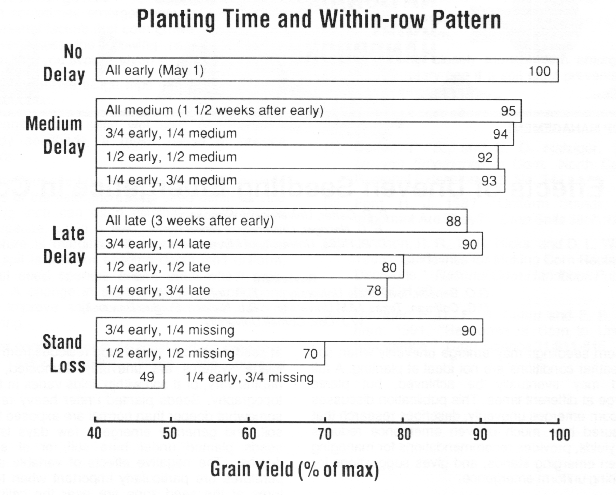
Figure 1. How Uneven Emergence Affects Grain Yield. Grain yields are shown
as percentages of the maximum yield of 187 bu./a. obtained with even emergence
of a full stand (26,000 plants/a.) with early planting. Yields are averages of
studies with two corn hybrids in seven environments in Illinois and
Wisconsin.
The stands shown in Fig. 1 include the following planting patterns:
- Full stands of 26,000 plants/acre with even emergence at early, medium,
and late planting dates.
- Full stands of 26,000 plants/acre with various combinations of uneven
emergence within rows with 1/4, 1/2, and 3/4 delayed plants.
- Reduced stands with 1/4, 1/2, and 3/4 stand loss.
To imitate emergence delays, corn was planted either 1 1/2 weeks (medium)
delay) or 3 weeks (late delay) after the early date (no-delay) (see Fig. 1). To
assess within-row uneven emergence, repeating patterns of in-row planting time
were used for each of the two delayed plantings. These patterns produced 1/4,
1/2, and 3/4 delayed plants within the stand.
For stand loss, the same repeating patterns were used but with blanks rather
than delayed plantings, producing stand losses of 1/4, 1/2, and 3/4 (Fig. 1).
Grain yield and growth responses were similar for the seven environments in
which the study was conducted; the combined results are presented in Fig. 1.
Effects of Uneven Emergence
When the planting delay was 1 1/2 weeks (medium delay), mixed early and
delayed plantings within a row decreased yield by 6 to 8% (Fig. 1). Similarly, a
1 1/2 - week delay in planting the entire stand decreased yield by 5%. A 3-week
delay (late delay) in planting 1/4 of the plants within the row decreased yield
by 10%. Again, a 3-week delay in planting the entire stand decreased yield by
about the same (12%). A 3-week delay in planting 1/2 or 3/4 of the plants within
the row resulted in a yield loss of 20 to 22%.
Effects of Stand Loss
Stand losses of 1/4, 1/2, and 3/4 decreased grain yields 10, 30, and 51%,
respectively (Fig. 1). The benefit of late-emerging plants within a stand can be
assessed by comparing yield percentages of uneven emergence vs. stand loss. For
example, when 1/4 of the plants were planted 3 weeks late, yields were 90% of
maximum, the same yield obtained under a 1/4 stand loss. This indicates that the
presence of late plants did not contribute to overall yields. However, when 1/2
of the plants were planted 3 weeks late yields were 80% of maximum, 10% higher
than the yield under a 1/2 stand loss. This indicates that the presence of late
plants helped overall yields.
Recommendations for Dealing with Uneven Emergence
The first step in following the recommendations is to determine the general
pattern of non-uniform emergence. Patterns will vary from field to field as well
as within parts of fields. You should manage particular fields or parts of
fields according to the most prevalent emergence pattern.
Should Late-Emerging Plants Be Protected During Row Cultivation?
- If the delayed plants emerge only 1 1/2 to 2 weeks late, use shields and
avoid burying them during cultivation.
- Protect plants emerging 3 weeks late if 1/2 or more of the plants in the
stand are late-emergers.
- If less than 1/4 of the stand emerges 3 weeks late or later, it probably
will not pay to encourage their survival. Yields will be about the same
whether or not these delayed plants are buried during cultivation.
Should You Replant Stands with Uneven Emergence?
- If the delay in emergence is less than 2 weeks, replanting will have
minimal effect on yield, regardless of the pattern of unevenness.
- If 1/2 or more of the plants in the stand emerge 3 weeks late or later,
then replanting may increase yields by up to 10%. To decide whether to replant
in this situation, estimate both the expected economic return of the increased
yield compared to your replanting costs and the risk of emergence problems
with the replanted stand.
Should You Fill in a Poor Stand?
- When replanting a poor stand (1/2 stand loss or greater), you can either
tear (up the stand and replant the whole field, or fill-in the existing stand
and accept the resulting uneven emergence.
- If you replant within 2 weeks of planting the original stand, filling-in
the existing stand may be an option. Yields will be similar to those from a
uniform-emerging, replanted stand, if you can get relatively uniform plant
spacing within the row between old and new plants. However, within 2 weeks of
planting, it probably will be too early to determine what the final stand will
be.
- If you replant 3 weeks after the initial planting, yield potential is
about 10% greater if you tear up the field and start over with an
even-emerging stand, rather than just fill-in the original stand. Balance this
possible yield increase against the additional cost of tillage, seed, and
dryer fuel.
Other Considerations
- It may be more accurate to assess non-uniform emergence by comparing
growth stage differences between early and delayed emerging plants rather than
comparing time differences. The 1 1/2 and 3-week planting delays described in
this publication resulted in similar time delays in emergence. However,
emergence delays may vary with different environments, plus the actual time
delays may not be known. In the study described, at emergence of plants
delayed in planting by 1 1/2 there were 4 to 5 visible leaves (2 to 3 visible
leaf collars) on early plants. When plants were delayed 3 weeks in emergence,
there were 7 to 9 visible leaves (4 to 5 visible leaf collars) on early
plants.
- Plant populations can also influence the relative yield of late-emerging
plants. A Minnesota study found that when 1/2 of the plants emerged 2 weeks
late within final plant populations greater than 30,000 plants/acre, the
late-emerging plants made a much smaller contribution to total yield than
those occurring in final stands of 24,000 plants/acre or lower.
- Uneven stands typically yield lower than even stands due to direct
competition of plants at two different stages of growth next to one another.
Older plants generally out-compete younger plants for light, water, and
nutrients. In some cases, late-emerging plants are more vulnerable to silk
clipping by corn rootworm beetles. Severe silk clipping that occurs early in
the pollination process can interrupt pollination and reduce kernel set on the
ears.
- Late-emerging plants had higher grain moisture content at harvest. This
could result in harvested grain with varying moisture levels, which would
increase kernel damage and drying costs. Late plants also lodged more due to
smaller stems, weaker stalks, and fewer brace roots. During harvest adjusting
settings on combines for variable ear sizes between early and late plants is
difficult. These problems would be minimal with a 1 1/2 -week delay, but could
be serious with a 3-week delay.
Recommendations for Avoiding Uneven Emergence
Corn sometimes emerges unevenly because of environmental factors that corn
growers cannot control. Nevertheless, the following management practices can
help you avoid uneven stands.
- Avoid excessive tillage trips that dry or compact the seedbed.
- Remember that tilling wet soils often creates cloddy seedbeds, a major
cause of uneven stands.
- Check your seed depth during planting in several areas of the field.
Increasing seed depth as little as 1/2 inch can often eliminate most uneven
emergence within a field, when seed-zone soil moisture is marginal. If contact
between seed and soil is poor or seeding depth isn't uniform, adjust seed
openers and/or press-wheel pressure. A change in secondary tillage operations
may improve soil conditions for more uniform planting.
- Under conditions of substantial surface crop residue, adjust harvest,
tillage, and planting equipment so that residue cover over the row area is
distributed uniformly after planting.
- Use recommended herbicide application rates to avoid injuring corn.
- After planting, closely monitor corn emergence and use a rotary hoe if a
soil crust prevents uniform corn emergence.
References
[1] Carter, P. R., and E. D. Nafziger. 1989. Uneven Emergence in Corn. North
Central Regional Extension Pub. No. 344.
[2] Ford, H. J. 1987. ``Uniform Stands: How Important Are They?'' Crop Soils
39(7):12-13.
[3] Johnson, R. R., D. R. Hicks, and D. L. Wright. 1985. ``Guidelines for
Making Corn Replanting Decisions.'' National Corn Handbook Publication NCH-30.
[4] Nafziger, E. D., P. R. Carter and E. E. Graham. 1991. ``Response of Corn
to Uneven Emergence.'' Crop Science 31:811-815.
New 5/92
Cooperative Extension Work in Agriculture and Home Economics, State of
Indiana, Purdue University and U.S. Department of Agriculture Cooperating. H.A.
Wadsworth, Director, West Lafayette, IN. Issued in furtherance of the Acts of
May 8 and June 30, 1914. It is the policy of the Cooperative Extension Service
of Purdue University that all persons shall have equal opportunity and access to
our programs and facilities.