Native Grasses
 Tallgrass prairies once covered most of northern and western
Missouri. Over 15 million acres of native prairie welcomed the
westward-bound wagon trains. Pioneers found bison, elk, deer, bear, cougar and
an abundance of smaller animals such as turkey, quail and prairie chickens
living among these warm-season grasses.
Tallgrass prairies once covered most of northern and western
Missouri. Over 15 million acres of native prairie welcomed the
westward-bound wagon trains. Pioneers found bison, elk, deer, bear, cougar and
an abundance of smaller animals such as turkey, quail and prairie chickens
living among these warm-season grasses.
Early settlers discovered that the prairie, with more than 200 species of
grasses and forbs, was as fine a quality forage for domestic livestock as it was
for bison and elk. But the bison moved slowly across the plains, grazing
an area and then leaving it to recover, whereas the stockmen's fences
confined to small areas which they overgrazed. from lightning or Indian hunters
once had burned uncontrolled across the grasslands, the settlers suppressed
them. The result weakening of prairie plants which encouraged invasion of the
prairies by woody plants undesirable vegetation.
Man's response to the deterioration of prairies was to develop and plant
strains exotic grasses. By planting single species stands of tame grasses and
using large amounts of herbicides, pesticides and fertilizers, man could produce
more forage than the natural prairies had provided. Many landowners, however,
soon began to realize this boost in quantity of grasses required substantial
investment in manpower, equipment, chemicals and fertilizers. In an era of
ecological awareness, man realized the instability of a plant community composed
of only one species.
Though man cannot completely replace all the components of a virgin prairie,
it is possible to reestablish many prairie species. You can plant big bluestem,
little bluestem, switchgrass, Indian grass, sideoats grama and a number of
flowering plants singly or in combinations to provide many of the values of
native prairie.
Why plant native grasses?
- They are well adapted Native grasses achieve good growth, even on
some marginal soils. They have developed naturally under Missouri climate and
soil conditions; that is why they are called native grasses.
- They provide dependable forage production As weather patterns
change, native grass yields fluctuate less than those of tame grasses. Disease
and/or insects also have less effect on mixed stands. Native grasses grow
during summer when other grasses have stopped growing. Under proper range
management, a stand will produce forever.
- Maintenance is low Native grasses do not require pesticide or
herbicide applications to maintain a stand. Fertilizer is not needed unless
the stand is intensively managed. Planting native grasses also eliminates
equipment expenses associated with maintenance mowing.
- They have extensive root systems When properly managed, native
grasses have a fibrous root system 5-15 feet long. This deep root system
provides excellent soil-holding capabilities and drought tolerance.
- They increase soil fertility Ninety percent of the humus native
grasses produce is from regeneration of the root system and, therefore, is
incorporated directly into the soil. There is a complete regeneration of the
root system every three to four years.
- Livestock gains increase Native grasses provide lush grazing during
hot summer months. Higher summer nutrition allows livestock to gain weight
throughout the summer.
- They are excellent for wildlife Native grasses provide cover for
nesting areas. Mixed stands provide a diversity of seeds and insect
populations for both young and adult birds. Grasses provide green browse
during summer and remain upright to provide cover during severe winter
weather.
- They are attractive The lush foliage of native grasses produces
varying shades of blue and green in summer, red and gold in winter. Grasses
remain upright throughout winter.
Over five million acres of native warm-season grasses have been reseeded in
the plains states. The U.S. Fish and Wildlife Service and state wildlife
departments in the West have seeded some 25,000 acres as wildlife habitat.
Successful native grass plantings are reported as far east as New York. In the
last five years, Iowa farmers have seeded 4,000 acres to native warm-season
grasses for forage and erosion control. Native grass plantings are proving their
worth in forage programs, soil reclamation projects, erosion control, wildlife
habitat,
landscape and beautification projects.
Natural Resources Conservation Service tests in Nebraska showed that steers
on a rotational grazing system which included warm-season grass pastures gained
an average 70 pounds/head more than steers on a rotational system which
contained all cool-season grass pastures.
Pheasant nesting in Iowa was 70 percent higher in switchgrass plantings than
in an orchard grass-alfalfa hay field. Early June haying destroyed all nests in
the orchard grass-alfalfa field. Nest loss was reduced in switchgrass due to the
later haying date. Native grasses are used in seeding mixtures for roadsides in
Iowa, Kansas and Nebraska to increase soil-holding capabilities, plant diversity
for wildlife and aesthetics.
The true prairies of Missouri are almost gone. The Department of
Conservation, using Design for Conservation funds, is purchasing remnant tracts
to preserve areas representative of this part of our natural heritage. Private
organizations such as The Nature Conservancy and The Missouri Prairie Foundation
have acquired tracts which are preserved and managed in cooperation with the
Department of Conservation. The free-ranging bison and elk are gone from
Missouri. Resident black bear and cougar are gone. Prairie chicken populations
are drastically reduced. The prairie which sustained these animals is reduced to
remnant parcels. If you own land which contains true prairie, you control an
amazing natural resource. Properly managed, your native grassland can provide
forage, wildlife habitat and an attractive landscape for you and your
descendants forever.
Types of Native Grasses |
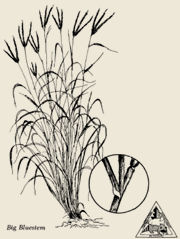
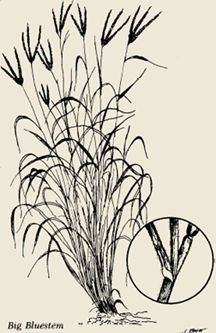 Big bluestem - a tall, warm-season sod-forming
grass. One of the most nutritious of the native grasses, it will grow
under a wide range of conditions. It is excellent for wildlife, cattle
production and beautification. Color ranges from bluish-green in summer to
reddish-brown in fall. This species begins growth in April and
produces seed in late August. It grows 5-8 feet tall and has a fibrous
root system up to 12 feet deep. Identified by its purplish hairy stems and
lower leaves, and a three-branched seed head from which its nickname,
turkey foot, is derived. Big bluestem - a tall, warm-season sod-forming
grass. One of the most nutritious of the native grasses, it will grow
under a wide range of conditions. It is excellent for wildlife, cattle
production and beautification. Color ranges from bluish-green in summer to
reddish-brown in fall. This species begins growth in April and
produces seed in late August. It grows 5-8 feet tall and has a fibrous
root system up to 12 feet deep. Identified by its purplish hairy stems and
lower leaves, and a three-branched seed head from which its nickname,
turkey foot, is derived. |
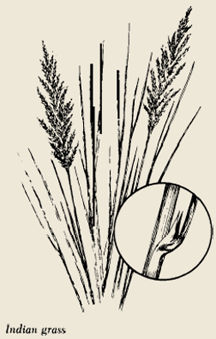 Indian grass - a tall, warm-season, sod-forming
grass. It grows on a variety of soils and provides nutritious forage.
Indian grass is excellent for wildlife, cattle grazing, erosion control
and beautification. It grows to a height of five or six feet. An important
vegetative characteristic is the claw-like extension of the sheath.
Identified by its golden color and the golden 4- to 12-inch-long plumelike
seed heads. Indian grass - a tall, warm-season, sod-forming
grass. It grows on a variety of soils and provides nutritious forage.
Indian grass is excellent for wildlife, cattle grazing, erosion control
and beautification. It grows to a height of five or six feet. An important
vegetative characteristic is the claw-like extension of the sheath.
Identified by its golden color and the golden 4- to 12-inch-long plumelike
seed heads. |
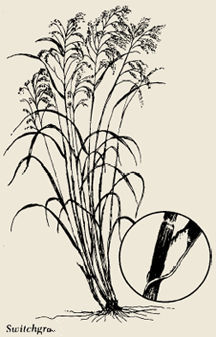 Switchgrass - a tall, warm-season, sod-forming
grass. Most common on prairie lowlands, it also is found in small, upland
patches. Its ability to remain in an upright position during ice and snow
makes it an excellent wildlife plant. It is a good grass for summer
grazing, waterways and erosion control. The Blackwell variety reaches a
height of four to five feet. Kanlow and Cave-in- rock varieties may get as
tall as 8-10 feet. Identified by its open seed head, which resembles
redtop, and a "V" shaped tuft of hair at the base of the leaf. Switchgrass - a tall, warm-season, sod-forming
grass. Most common on prairie lowlands, it also is found in small, upland
patches. Its ability to remain in an upright position during ice and snow
makes it an excellent wildlife plant. It is a good grass for summer
grazing, waterways and erosion control. The Blackwell variety reaches a
height of four to five feet. Kanlow and Cave-in- rock varieties may get as
tall as 8-10 feet. Identified by its open seed head, which resembles
redtop, and a "V" shaped tuft of hair at the base of the leaf. |
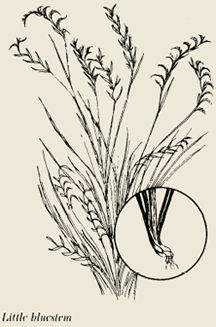 Little bluestem - a medium height, warm-season
bunch grass common on prairie uplands. Highly nutritious, it makes good
hay and will grow on thin, poor soils. In fall and winter its
reddish-brown color makes it one of the most beautiful grasses on the
prairie. It reaches a height of two to four feet and has a dense
root system which may reach 5-8 feet deep. Identified by its purplish
color, clumpy growth pattern and flattened stems. Little bluestem - a medium height, warm-season
bunch grass common on prairie uplands. Highly nutritious, it makes good
hay and will grow on thin, poor soils. In fall and winter its
reddish-brown color makes it one of the most beautiful grasses on the
prairie. It reaches a height of two to four feet and has a dense
root system which may reach 5-8 feet deep. Identified by its purplish
color, clumpy growth pattern and flattened stems. |
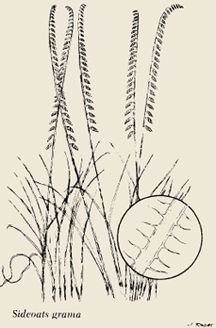 Sideoats grama - a medium height, warm-season
bunch grass. This grass is ideal for use with other grasses on hard-use
areas such asplaygrounds; it's a little tall for lawn use. An ideal grass
to include in plantings for wildlife, grazing and erosion control, it
reaches a height of two to three feet. It will not do well on wet sites or
areas with temporary standing water. Sideoats grama turns reddish-white in
fall. Identified by bumps and hairs on leaf edges and seeds that tend to
hang down on one side of the stem, giving it the name "sideoats." Sideoats grama - a medium height, warm-season
bunch grass. This grass is ideal for use with other grasses on hard-use
areas such asplaygrounds; it's a little tall for lawn use. An ideal grass
to include in plantings for wildlife, grazing and erosion control, it
reaches a height of two to three feet. It will not do well on wet sites or
areas with temporary standing water. Sideoats grama turns reddish-white in
fall. Identified by bumps and hairs on leaf edges and seeds that tend to
hang down on one side of the stem, giving it the name "sideoats." |
|
If you do not own a prairie, but wish to derive the benefits of
re-establishing a stand of native grasses and forbs, contact the nearest
Missouri Department of Conservation representative or write to: Missouri
Department, of Conservation, P.O. Box 180, Jefferson City, Missouri 65102
Other native grass brochures available from the Department of
Conservation:
- Establishing native grasses
- Native grasses for wildlife
- Native grasses for Missouri stockmen
|
 Click
here to view the .pdf Document ID: --
Click
here to view the .pdf Document ID: --
Content revision:
200307014
 Use of
this site is subject to certain Terms &
Conditions.
Use of
this site is subject to certain Terms &
Conditions.
Copyright (c) 1995-2002 Conservation Commission of Missouri.
All rights reserved. Reproduction in whole or in part in any form or medium
without express written permission of the Missouri Dept. of Conservation is
prohibited.
News Organizations: see permissions
under Terms and
Conditions.
URL: http:// www.conservation.state.mo.us /landown/grass/native2/index.htm
Last modified: Monday, 14-Jul-2003 14:06:02
CDT